
Luffing Jib vs Flat-Top Tower Crane: Which Should You Buy for Construction, Resale or Rental?
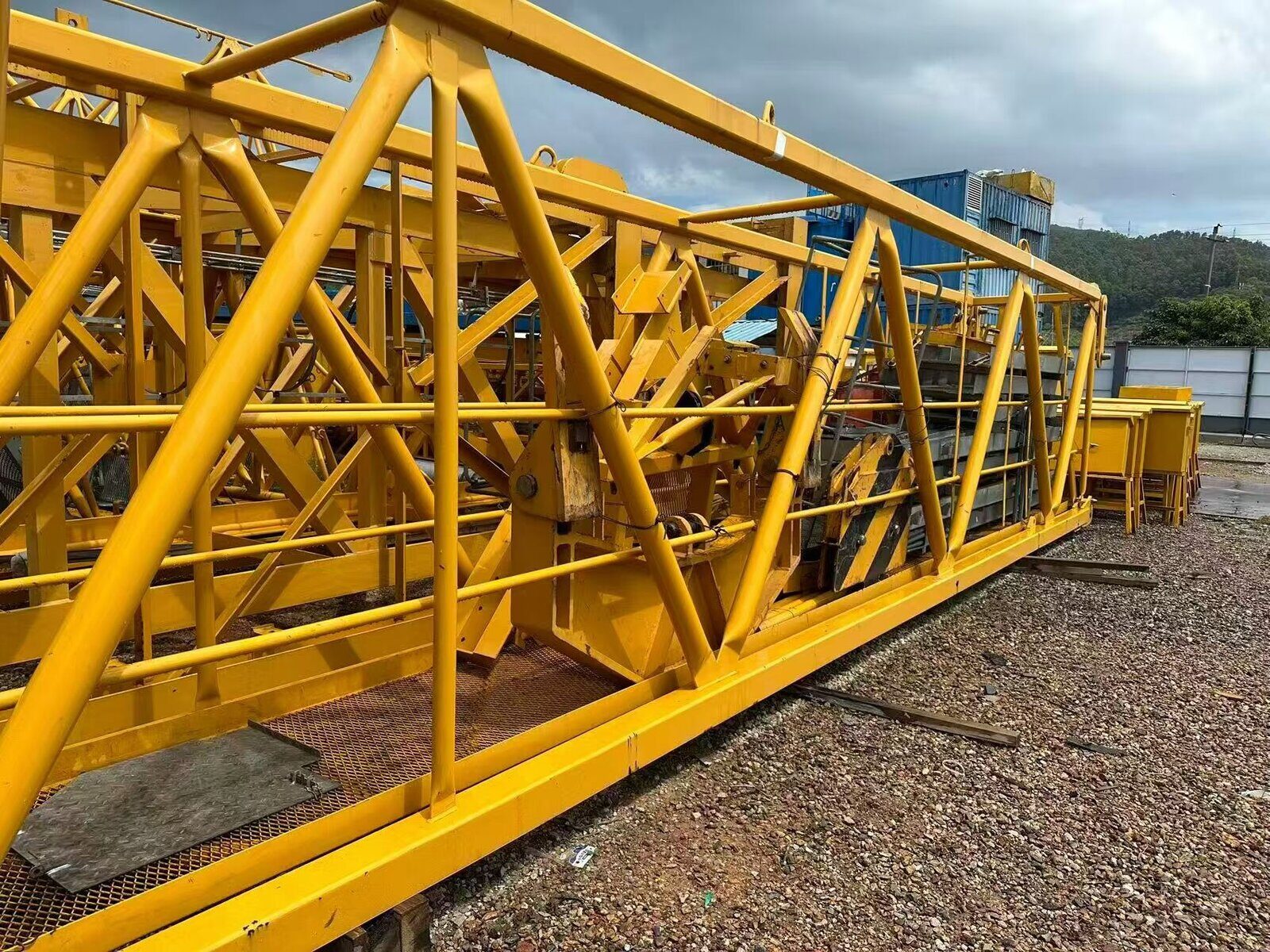
Short answer: shortlist a flat-top tower crane when its working and parking envelopes fit the intended site and its exact load chart covers the required lifts. Shortlist a luffing-jib crane when restricted airspace makes a horizontal jib impractical—but only after confirming its permitted working geometry and manufacturer-specified out-of-service position.
Which crane should you shortlist first?
Your business model then determines which acceptable crane is the better purchase:
- Construction contractors: prioritize project suitability, installation readiness and continuity of critical lifting work.
- Equipment dealers: prioritize a documented configuration that identifiable customers can use and that you can resell transparently.
- Rental companies: prioritize realistic demand, serviceability and compatibility with the jobs your fleet actually serves.
The cheapest purchase can become expensive in three different ways: a delayed project, unsold inventory or an idle rental asset.
What changes when you buy a tower crane for construction, resale or rental?
| Buyer | The real purchasing question | Pain points to investigate | Evidence that supports the decision |
|---|---|---|---|
| Construction contractor | Can this crane complete our planned lifts and be ready when the project needs it? | Wrong capacity at radius, installation delays, unsuitable parking clearance, missing components and breakdowns during critical work | Reviewed site layout, configuration-specific load chart, complete component list and installation responsibilities |
| Equipment dealer | Can I resell this exact configuration without unexpected repairs or disputes? | Slow-moving stock, undocumented repairs, mismatched parts, weak condition evidence and working capital tied up | Target-customer requirements, traceable components, inspection findings and a costed rectification list |
| Rental company | Will this crane earn paid hire days without excessive downtime or transfer costs? | Weak utilization, costly erection and dismantling, spare-parts delays, specialist maintenance requirements and unsuitable fleet mix | Actual enquiries or bookings, service support, mobilization quotations and maintenance records |
Selection advice: decide what the crane must achieve for your business before comparing model names.
A machine suitable for one contractor’s project may be difficult for a dealer to resell. A specialist luffing crane may serve a rental company well—or remain idle if its customers do not need that configuration.
Why can a crane fit the lifting task but still fail the site?
Because a tower crane needs space in two different conditions:
- Working: lifting, positioning loads and moving through its intended operating area.
- Out of service: unattended in its prescribed parking and wind-response condition.
This distinction is important for all three buyers. Contractors need a workable installation. Dealers need to understand the constraints they are selling. Rental companies need to know which customer sites a unit can realistically serve.
Manufacturer developments reinforce the importance of geometry. On 5 April 2024, Manitowoc introduced the Potain MR 309 and MR 329, highlighting reduced out-of-service radii among improvements requested by customers. Manitowoc’s announcement.
On 11 February 2025, Liebherr introduced the 620 HC-L, also emphasizing compact geometry and its out-of-service position for constrained sites. Liebherr’s announcement.
Our interpretation: operating and parking space deserve their own purchasing assessment. These developments are not proof that every buyer needs a luffing crane, and newer models’ parking figures must not be applied to older used units.
What is the practical difference between luffing-jib and flat-top tower cranes?
| Decision factor | Flat-top tower crane | Luffing-jib tower crane |
|---|---|---|
| Working-radius adjustment | A trolley travels along a horizontal jib. | The jib changes angle to adjust working radius. |
| Horizontal footprint | Moving the trolley inward does not shorten the jib. | Raising the jib can reduce its horizontal projection within the permitted configuration. |
| Site-clearance assessment | Check the jib, counter-jib, load path and prescribed parking arrangement. | Check changing jib geometry, counter-jib, load path and prescribed parking arrangement. |
| Used-mechanism focus | Trolley drive and ropes, alongside hoist and slewing systems. | Luffing drive, ropes and brakes, alongside hoist and slewing systems. |
| Sensible shortlist condition | Adequate horizontal clearance and a suitable lifting configuration. | A genuine space constraint that variable jib geometry can address. |
| What neither design guarantees | Project approval, acceptable condition or profitability. | Project approval, acceptable condition or profitability. |
Neither crane type is automatically superior on a multi-crane site. Actual heights, operating envelopes, parking positions and coordination arrangements determine suitability.
Which tower crane should a construction contractor choose?
Start with the critical lifting work—not the advertised maximum tonnage.
For a contractor, the main risk is discovering a configuration problem after shipping, foundation preparation or erection has already been arranged.
Document:
- The heaviest loads and their pickup and placement radii.
- Required hook height through each construction stage.
- Site access and erection constraints.
- Foundation and tie arrangements requiring engineering review.
- The date lifting must begin and the consequences of a delay.
Shortlist a flat-top if it can serve the required working area and park appropriately without unresolved restrictions.
Shortlist a luffing-jib crane if restricted airspace creates a genuine advantage and both its working and parking arrangements are feasible.
Compare the cost of a crane ready to perform the planned work, not just the machine purchase price. Obtain quotations for repairs, transport, erection, dismantling and relevant installation arrangements.
Do not treat an unresolved safety or suitability problem as something a purchase discount can compensate for.
Which used tower crane should an equipment dealer buy for resale?
Buy for an identifiable customer segment, not an assumed “easy resale.”
Before purchasing, ask whether your likely customers need the offered capacity, jib configuration, tower system and installation arrangement.
A dealer’s concern is not only visible condition. It is uncertainty that becomes expensive after acquisition:
- Does the crane include the components needed for the configuration you intend to advertise?
- Are repairs documented clearly enough for the next buyer to evaluate?
- Can replacement parts be identified and sourced?
- Will destination-specific requirements change the likely customer pool?
- What will inspection, rectification, storage and logistics cost before resale?
Prefer a flat-top candidate when verified customer enquiries support that configuration.
Consider a luffing candidate when you have credible demand from buyers facing suitable site constraints—not simply because the model appears more specialized.
Calculate resale margin after the costs you will actually bear, including acquisition, repairs, logistics and inventory carrying costs. Do not assume the difference between asking prices is achievable profit.
Dealer selection rule: a complete, traceable configuration with a credible buyer profile is more useful than an attractive model name with missing evidence.
When does a luffing-jib crane make sense for a rental company?
When suitable demand and service capability justify adding it to the fleet.
A higher quoted rental rate does not establish a better return. It must be considered alongside paid hire days, downtime, mobilization costs and ownership costs.
Review your actual enquiry and booking history:
- How many potential jobs require restricted-site capability?
- Can the offered crane meet those jobs’ lifting and parking requirements?
- Who will maintain its luffing mechanism and safety systems?
- What are the lead times for configuration-specific replacement parts?
- How much will erection, dismantling and transfer cost?
- Could the unit overlap unnecessarily with equipment already in your fleet?
Prioritize a flat-top candidate when your recurring jobs suit its configuration and service arrangements.
Consider a luffing candidate when constrained-site enquiries are credible and your team can support the unit.
Common parts or tower systems can be commercially useful, but compatibility must be documented. Never mix components simply because they appear interchangeable.
Rental selection rule: buy against realistic job demand and support capacity—not a premium day rate considered in isolation.
What must all three buyers verify before paying a deposit?
Use three purchasing gates: Site, Load and Condition. This is a screening framework, not an engineering certification.
Can the crane work and park within an acceptable arrangement?
Review both envelopes against neighboring structures, other cranes, restricted areas and applicable permissions. Include the rear counter-jib and later construction stages.
Do not assume operating zoning resolves out-of-service clearance.
The UK Health and Safety Executive’s 20 February 2014 alert explains that an incorrect parking radius or an engaged slew brake can prevent a luffing crane from weathervaning as intended, creating dangerous wind loading. Obtain current instructions for the specific unit rather than improvising a parking position. HSE safety alert.
Does the exact configuration cover the required load at radius?
Request the manufacturer’s load chart for the offered variant, jib length, reeving and relevant installation configuration.
Illustrative example—not a lifting instruction: an item weighing 2.40 tonnes plus 0.25 tonnes of lifting accessories gives a 2.65-tonne combination. The planning team must account for this and any further deductions required by the applicable load-chart convention.
A candidate providing only 2.50 tonnes of usable capacity at the critical radius fails that screen, regardless of its advertised maximum capacity.
A candidate providing 3.00 tonnes can remain under consideration. That does not constitute approval of the lift.
Is the offered unit complete and its condition documented?
Match serial identification and component records to the machine being offered. Review repairs, structural findings, mechanisms and unresolved defects.
If the crane is dismantled, separate inspections possible before shipment from checks required after erection.
For contractors, this protects installation readiness. For dealers, it supports transparent resale. For rental companies, it establishes a clearer maintenance and acceptance baseline.
Which inspection standards and test results should you request?
Useful references address different parts of the assessment:
- ISO 12480-3:2020, the 2020 edition, addresses safe use of tower cranes, including planning, selection, erection, operation and maintenance. ISO overview.
- ISO 9927-3:2019, the 2019 edition, addresses regular tower-crane inspections. It explicitly excludes inspection before first use, so it is not a complete commissioning procedure. ISO inspection overview.
- ISO 4309:2017, the 2017 edition, addresses steel wire-rope care, inspection and discard. ISO wire-rope overview.
Ask for findings, not just a statement that the crane “passed.”
| Evidence | Useful recorded information | Purchasing significance |
|---|---|---|
| Load-chart assessment | Capacity in tonnes at critical radii in metres, with configuration identified | Helps avoid buying a crane that cannot perform the intended lifts. |
| Working and parking assessment | Relevant radii, heights, positions and clearances | Helps identify which sites the crane can serve. |
| Wire-rope report | Rope identification, measured diameter, broken-wire findings, corrosion and other deterioration | Helps define repair or replacement requirements. |
| Structural and connection inspection | Component identities, measured wear, repairs and examination findings | Supports condition assessment and component traceability. |
| Mechanism and safety-device checks | Device identification, procedure, findings and corrective actions | Makes functional claims more specific and auditable. |
Acceptance criteria must be appropriate to the machine, components and applicable requirements. Qualified personnel should carry out functional checks and any load testing under approved procedures.
A standard number on a quotation is not proof of compliance. Do not improvise an overload test or use a generic internet threshold to judge a crane.
Which listed models could start a useful comparison?
Sxmachine’s POTAIN MCT 328 product page provides a starting point for discussing a flat-top candidate’s offered variant, jib configuration and critical-radius capacity.
The 2014 POTAIN MCR225 product page provides a starting point for requesting a luffing candidate’s exact configuration, parking instructions and mechanism inspection evidence.
Apply different commercial questions to the same technical evidence:
- Contractor: does this configuration fit our project and installation schedule?
- Dealer: which identifiable customers could use this configuration?
- Rental company: which credible bookings could this unit serve, and can we maintain it?
Confirm current availability, serial identification, included components and documentation. Neither listing alone establishes suitability, resale demand or rental performance.
What should each buyer include in the pre-purchase checklist?
What should a contractor add?
- Critical lifts are covered at their required radii.
- Foundation, tie arrangements, access and erection responsibilities are reviewed.
- Delivery and installation timing align with the construction programme.
What should a dealer add?
- Target customers and their configuration requirements are identifiable.
- Repairs and condition can be disclosed accurately to the next buyer.
- Expected resale economics include rectification, logistics and inventory costs.
What should a rental company add?
- Demand assumptions are supported by enquiries, bookings or customer requirements.
- Parts availability and maintenance capability support the offered unit.
- Paid hire days, transfer costs and downtime are included in the commercial assessment.
What should you send to get a recommendation relevant to your business?
When contacting Sxmachine, identify yourself as a contractor, dealer or rental company.
Then provide the information that changes the recommendation:
- Contractors: site layout, critical loads and radii, required height, destination and installation date.
- Dealers: target market, customer applications, preferred configurations and required condition documentation.
- Rental companies: typical job requirements, fleet configurations, credible upcoming demand and service arrangements.
Contact Sxmachine to compare suitable listed configurations. Request current availability, configuration-specific documents and inspection evidence before narrowing your shortlist.
Contractors buy lifting capability for a project. Dealers buy a configuration they can resell transparently. Rental companies buy an asset they can place and support. The right tower crane must pass the technical checks—and fit the business that will own it.