Tower Crane Mast Sections Pins and Bolts Compatibility Checklist
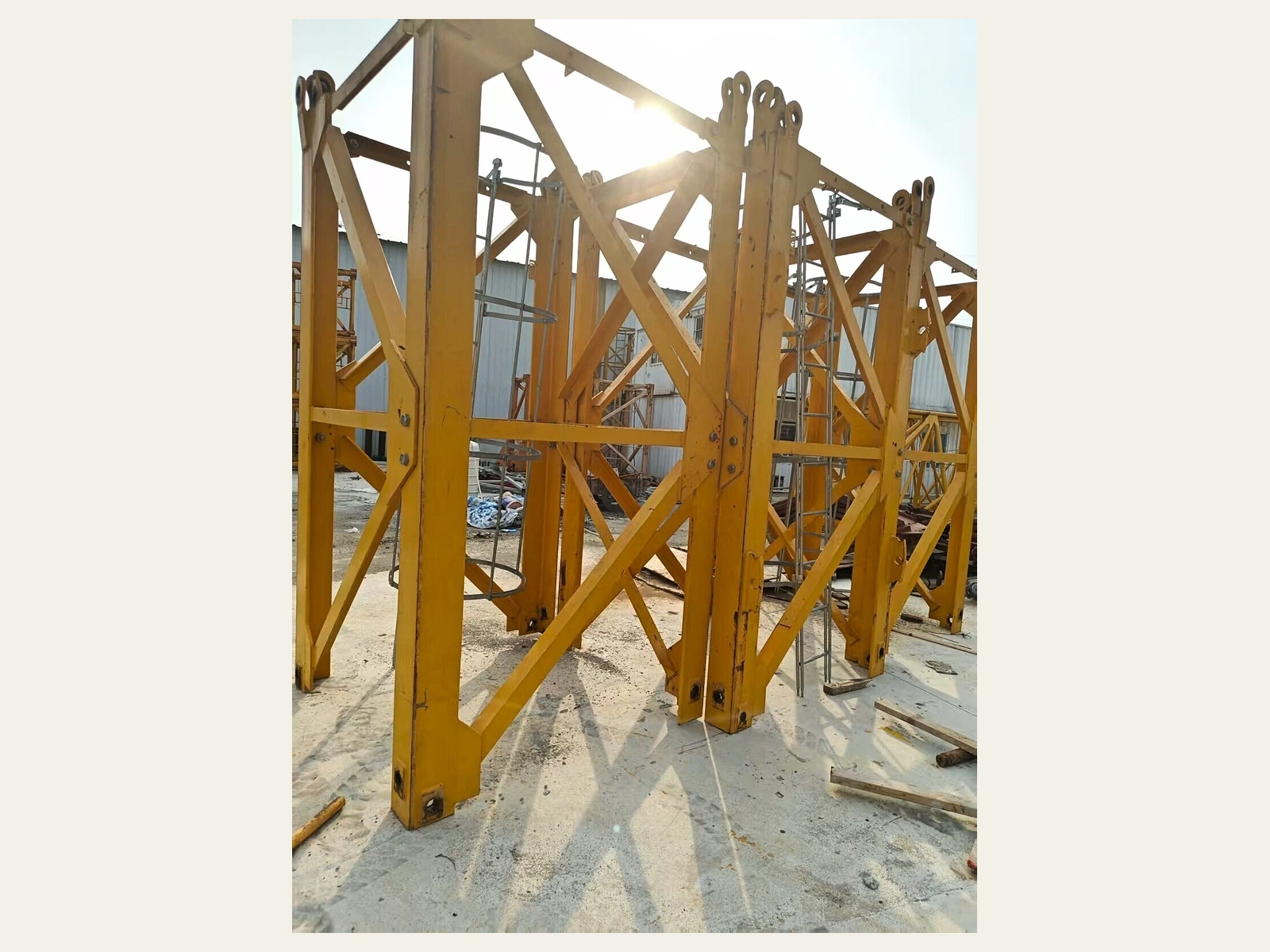
Steel section connections and joint details, photographed in an equipment yard.
Two tower-crane parts can look identical, share a square section size or accept the same pin, yet still belong to different approved assemblies. Before ordering a mast section, connection pin, structural bolt or replacement mechanism, establish exactly what the crane requires and what the offered item is.
Before you request a quote
The useful purchase question is specific: which documented configuration accepts this identified part, and what evidence connects the delivered item to that specification? A dimension-only enquiry often leaves that question unanswered.
Identify the crane before identifying the replacement
Start with clear photographs of the crane identification plate, the affected assembly and any markings on the existing part. Record the full model, serial number, mast-system designation and part number. Include drawing or parts-list references and revision information when available.
If a number is unreadable, label it as unknown. Send the assembly photographs and available records for identification instead of supplying an estimated number. State whether the replacement is for an existing configuration or a proposed change in tower height, support arrangement or equipment specification.
Describe a mast section as an assembly
Record the section designation, overall dimensions, connection design, connector positions and any markings. Photograph its ends, main members and connections, together with ladders, platforms or other fittings that affect the proposed installation. Identify any transition or connecting section already in the tower.
Manufacturer documentation distinguishes named systems and connecting components. Potain's parts reference catalogue, for example, identifies specific mast families, connecting masts and fixing-angle variants. That is evidence for ordering by a documented system and designation; it is not approval to interchange other sections because their outside dimensions match. Potain Quick References catalogue.
For a used section, request its identification and history as well as current photographs. Separately flag visible deformation, corrosion, connection wear or repair marks for appropriate assessment. A compatibility match and a satisfactory condition assessment answer different questions; one cannot replace the other.
Order the complete specified connection
For pins, ask for the approved part reference, dimensions, retaining arrangement and the mating component. Include photographs of the shoulders, grooves and retaining features. A pin entering a hole establishes physical fit, not suitability for the crane's loads or assembly.
For bolts, request the specified diameter, thread, length, property designation, coating and associated nuts or washers, as applicable to the approved assembly. Ask for the manufacturer's installation reference, including any applicable reuse restrictions. Do not invent a tightening value from a generic internet table or select a substitute simply because its stated grade is higher.
Distinguish an identified replacement from a change affecting capacity or safe operation. In the United States, OSHA's equipment-modification provisions require specific approval routes for such changes, including updated documentation where necessary. That illustrates why substitution needs a defined technical basis; the applicable requirements must be checked for the project's jurisdiction. OSHA equipment-modification provisions.
Keep mechanisms and their records together
Apply the same identification process to slew motors, brakes, gearboxes and other assemblies. Include the mechanism plate, electrical or interface information, existing part reference and service history. Ask which accessories and mating components are included, rather than inferring them from a sales photograph.
HSE has highlighted cases where exchanged tower-crane components were not adequately reflected in maintenance histories. Its alert calls for individual identification and for service records to follow exchanged components. Keep received-part identification, inspection findings and the installation record linked to the crane that receives it. HSE guidance on component traceability and slew mechanisms.
Send a useful parts enquiry
| Field | Information to supply or request |
|---|---|
| Crane identity | Manufacturer, model, serial number, plate photographs |
| Existing assembly | Mast system or mechanism, current configuration, connection photographs |
| Requested item | Part number, drawing reference, revision and quantity |
| Proposed replacement | Identifying marks, specification and applicable compatibility evidence |
| Used-part condition | Available history, current photographs and unresolved assessment points |
| Delivery scope | Pins, retainers, bolts, nuts, washers and accessories included or excluded |
Before accepting delivery, reconcile the item markings and quantities with the agreed order. Keep unidentified or substituted items separate until the responsible technical team resolves them. Do not treat dispatch photographs as confirmation that installation requirements have been satisfied.
Frequently asked questions
Can I order a mast section using its width alone?
No. Width helps identification, but the system designation, connection, configuration and supporting documentation must also match.
Can a higher-grade bolt replace the specified bolt?
Do not assume that it can. Confirm the complete specified connection and any proposed substitution through the appropriate technical review.
What should I do when the original part number is missing?
Send the crane identity, assembly photographs and available drawings. Keep the identity unresolved until a reliable specification is established.
Request unit-specific information
Browse the tower-crane spare-parts pages. When making an enquiry, include the crane identity and the checklist above so the discussion starts with the actual assembly.