
Construction Hoist Sizing for Traffic Door Openings and Site Planning
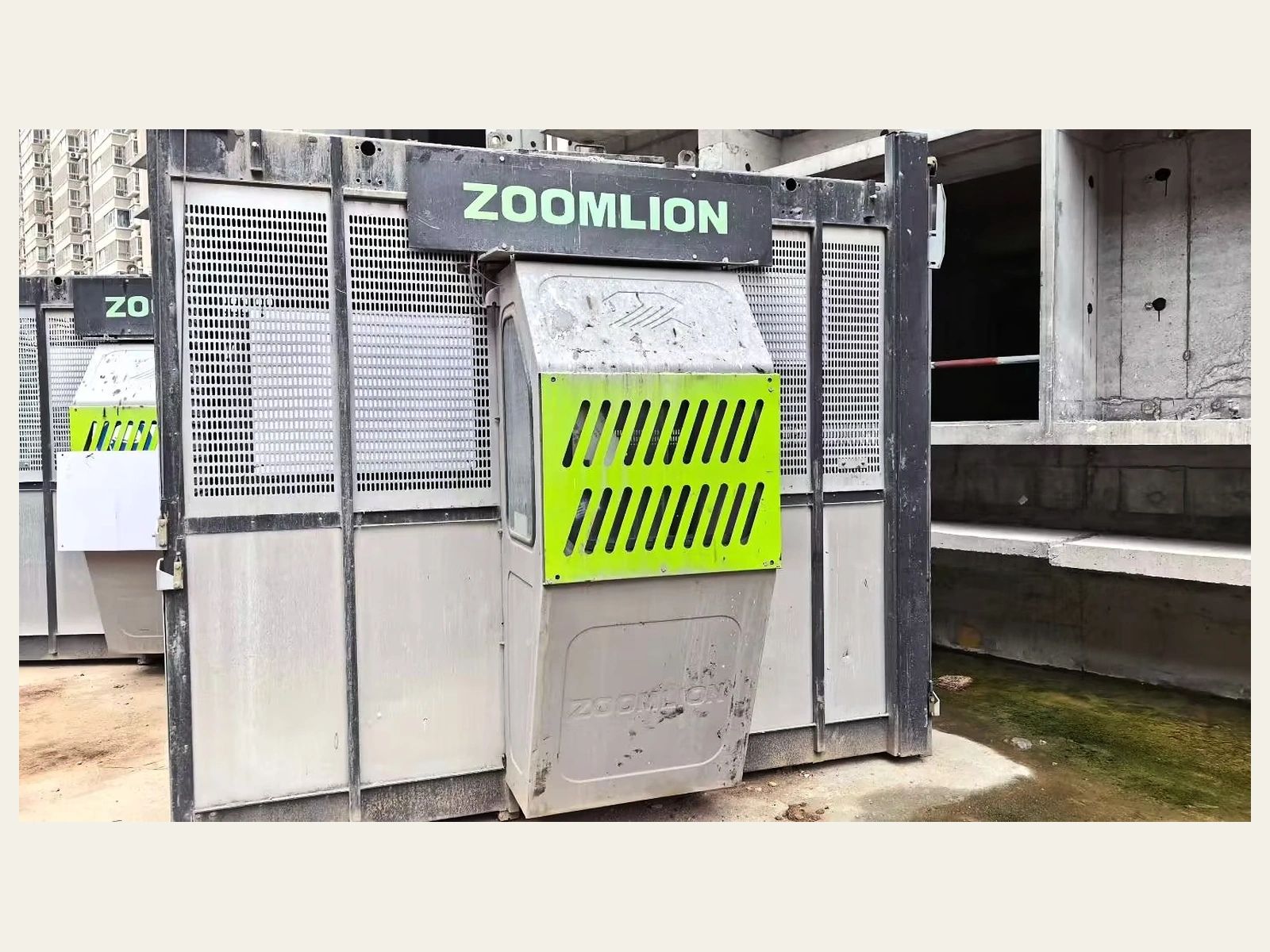
Construction hoist cages, entrances and the adjacent building interface.
A construction hoist can match the requested payload and still leave workers queuing or materials waiting at ground level. A useful quotation starts with your site's transport demand, access geometry and approval requirements—not just a model number or cage length.
Before you request a quote
Treat the following as procurement screening. The manufacturer documentation for the exact offered configuration, together with the responsible project professionals, must establish its permitted use and site suitability. Alimak documents below illustrate the kinds of parameters to request; their specifications do not describe the Zoomlion or Dahan units listed on this website.
Describe the busiest transport window
“We have 200 workers” does not explain when they need transport or where they are going. Record the busiest shift-change or break period, the floors being served and how arrivals are spread across that period. Separate personnel demand from scheduled deliveries, trolleys, pallets and bulky packages.
Ask the supplier or project transport planner to compare candidate configurations against the same demand scenario. Request the assumptions behind the proposed traffic assessment: floor distribution, number of stops, loading and unloading allowances, return journeys and calls competing for the same car. A daily average can hide the queue that delays the first hour of work.
Keep demand counts separate from permitted occupancy. Do not convert an advertised kilogram rating into a passenger allowance.
Check the complete access envelope
A “2.5 m cage” description does not establish the clear door width or height. Request dimensioned drawings showing usable internal space, car entrances, landing openings and the approach space at the relevant floors. Give the supplier the largest package's outside dimensions, including its pallet, packaging or trolley, and its declared weight.
Door arrangement matters as well as cage size. For example, Alimak separately describes bulky-material applications, car configurations and an optional long-side door in its Scando 650 XL product information. Those are examples of questions to ask about your offered unit, not options to assume it has.
Request written confirmation of the intended personnel/material use and its limitations. An attractive cage photograph cannot establish either access clearance or suitability for a particular load.
Compare payload, speed and the proposed cycle assumptions
Maximum travel speed alone does not tell you how many site requests a hoist will serve during a peak window. Stops, handling time, floor distribution and the proposed call-control arrangement also affect the traffic assessment.
Compare documented payload, usable cage dimensions and speed for the exact configuration as separate fields. Alimak's Scando 650 range page presents these separately and links configuration-specific specification sheets. Request equivalent unit-specific evidence from the supplier rather than transferring another manufacturer's values.
Ask for the proposed car arrangement and control features to be identified in the quotation. Have the project team review whether the stated assessment assumptions match the actual work programme; a faster headline speed does not by itself resolve competing deliveries and personnel demand.
Resolve site interfaces before comparing prices
Provide the final travel height, planned floor stops and any staged changes as the building progresses. Request the manufacturer's applicable foundation, mast, tie and landing-interface requirements for engineering review, with responsibilities and exclusions clearly assigned.
Also identify the site's available voltage, frequency and phase, and request the offered configuration's electrical supply requirements. Manufacturer literature can list power and control information, as the Alimak Scando 650 brochure demonstrates. Your project electrician and responsible engineers must review the actual unit and site documents. A general brochure is not approval for your building connection or power supply.
Copy this RFQ checklist
Send the same brief to each shortlisted supplier:
- Project: country, site, construction stage and required availability date.
- Intended use: personnel, materials or both; request confirmation of permitted uses.
- Peak demand: busiest time window, arrival pattern and destination floors; these are demand figures, not occupancy limits.
- Material envelope: largest packaged item or trolley dimensions and declared weight.
- Travel: final height, floor-stop schedule and planned stage changes.
- Access: required clear door dimensions, entrance sides and landing/approach drawings.
- Site power: available voltage, frequency and phase, subject to project electrical review.
- Offered unit: make, exact model, serial identification, configuration and applicable manufacturer documents.
- Engineering interfaces: requested foundation/tie/landing requirements, review responsibilities and approval documents.
- Scope: included mast sections, doors, landing equipment and controls; identify exclusions and confirm availability separately.
Frequently asked questions
Is the advertised payload enough to choose a hoist?
No. Check the exact configuration's documented permitted use, access dimensions and suitability for the site's demand. Payload is not a passenger-count calculation.
Will a faster hoist remove peak queues?
Not necessarily. Request a traffic assessment with stated assumptions for stops, handling time, calls and demand distribution before comparing speeds.
Can a catalogue confirm that the hoist fits our site?
It can support an initial shortlist. Site suitability still requires the actual unit's documentation and review of the building interfaces, power and local approval requirements.
Request unit-specific information
Browse the construction hoist category, then send your project brief to request unit-specific information and clarify the quotation scope.